
Experiencing the depths of Jesus Christ

Image by Leopictures from Pixabay
One of three main reasons that mission workers are drawn to 2HC or a similar formational cohort experience is a longing for more depth in their relationship with Jesus.[1] (Perhaps like the bee pictured above, we want to plunge into the depths of that encounter!)
Here is how one 2HC member described it:
I think though that through all the goodbyes and seeing all the brokenness over the years, I need renewed emotional capacity to continue. I also feel a calling to shift from doing ministry to being with Jesus and to more engagement in intercession. Now … it seems like the right time to pursue this deeper calling within my current calling.
How might we experience that depth of relationship with Jesus? The title of this blog is taken from a book written almost 350 years ago by a French Christian named Jeanne Guyon, also known as Madame Guyon. [2] Despite being imprisoned twice at the instigation of church authorities (the second time for more than seven years), her writings have endured in influence over the years, particularly in certain streams of Christian spirituality.
As I have grown into a “2nd half of life” spirituality, I am drawn to a depth of relationship with Christ that is characterized by simpler and slowed-down rhythms. Guyon’s descriptions of the “prayer of simplicity,”[3] of turning to the presence of Christ within, where Christ dwells within our hearts (cf. John 14:23 and Ephesians 3:17), resonate with these longings.[4]
In addition, Guyon wrote especially for believers who could not read and write.[5] I lived for many years alongside oral learners, either those unable to read or write or who preferred oral rather than written methods of learning and communication. I knew that I needed to model simple, repeatable ways of encountering Jesus and going deep into relationship with Christ. But that meant that I too needed to deepen into a faith of encounter with the living Christ, rather than simply a faith of accumulated spiritual insights. I needed ways to unentangle myself from the typical markers for success that characterized my life and leadership in mission. I needed to learn – and I am still learning – how to “lead” by being alongside, in simplicity and humility and love.
Guyon’s descriptions of the “prayer of simplicity” offer one guide to experience more fully and more deeply the presence of Christ within. There may be other devotional writers you’ve enjoyed with whom you can reconnect.
If you are longing for more depth in your relationship with God, what might be some other ways to experience that depth?
How will you slow down enough to pay attention to what your body and your soul are saying?
Who can help you by listening well and inviting you to articulate what you are longing for?
Pause for some minutes before reading further. Or perhaps you need to stop reading now and simply stay in a place of quiet attentiveness to the Lord and what you are sensing….
_________
If it is helpful, here are a few suggestions for exploring some new pathways toward a deepening of your relationship with Christ:
Talk with a spiritual director who can help you pay attention to your God-given longings and where you might be resisting (often subconsciously) that desire for God
Try your heart and your hand at writing poetry. Poetic expression has a way of releasing the need to be precise or comprehensive. It simplifies the expression of your heart, often through image and metaphor. Let that slowed-down simplicity draw you to an encounter with Christ. Here’s a poem I wrote recently as I reflected on several scriptural passages in light of recent world events:
God says, “I love you!”
“But I am weary …”
“Yes, and you are loved.”
“But I am alone …”
“No, you are loved … by Me and by many.”
“But there is much bad and hatred in this world!”
“Yes, I am troubled and full of sorrow. Death sneers and threatens to overwhelm this world. But now, be still … quietly remember my great mercy and love, for they are from of old. Ancient and carved into this world’s bedrock, my love is stronger than death.”Make a drawing, perhaps inspired by an event in the life of Jesus. You can use pencil and paper or create something digitally (e.g., I have created images on Canva, combining photos with short Scripture verses). As with poetry, drawing can help you slow down and stay simple. Here’s a drawing based on John 5:1-9 and inspired by Sybil MacBeth’s Praying in Color: Drawing a New Path to God (Brewster, Massachusetts: Paraclete Press, 2007)
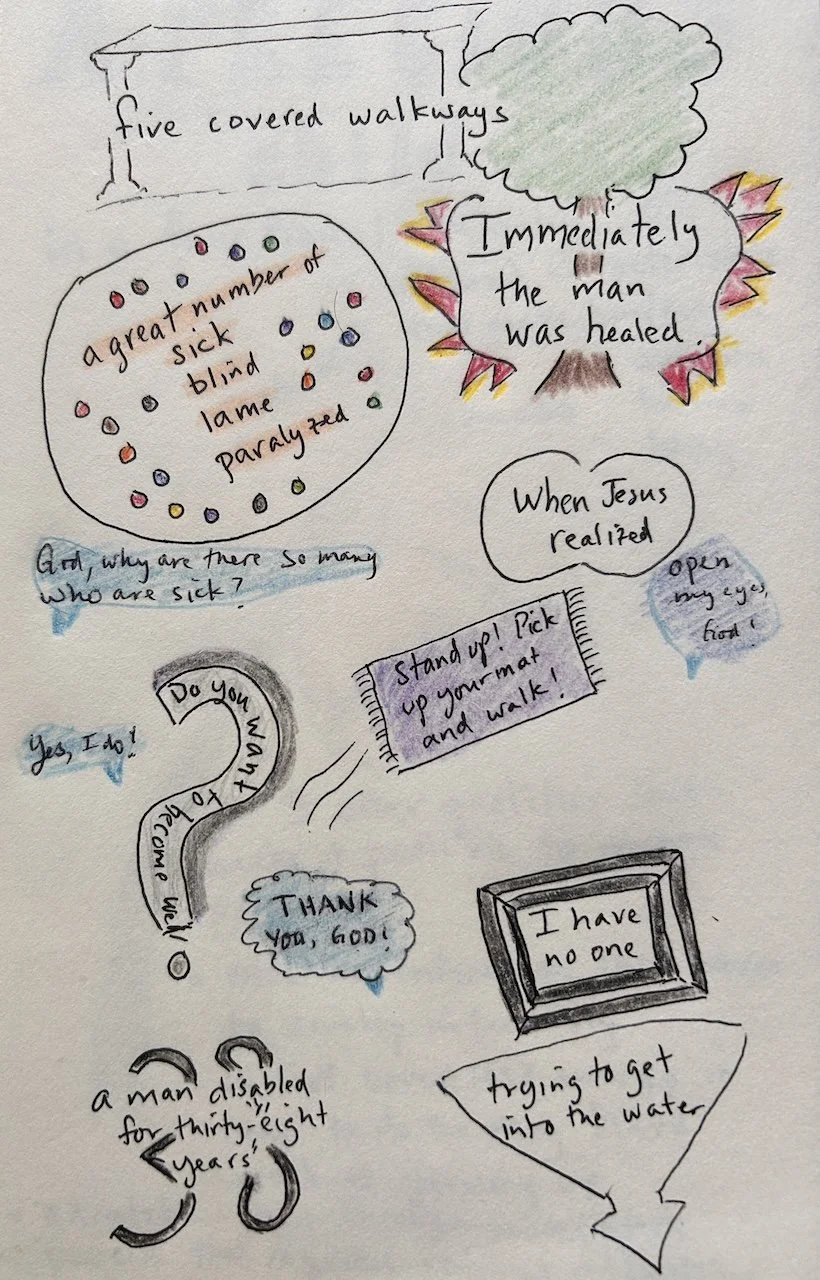
____________________
[1] The other two reasons are that they 1) seek help as they navigate an unexpected season (or seasons) of disorientation in their life, and 2) need greater capacity for discernment as they face a time of life and ministry transition.
[2] Experiencing the Depths of Jesus Christ (Goleta, CA: Christian Books, 1975) is a modern and simplified rendering in English of her original, written in 1685. The original was entitled, “Moyen court et tres facile de faire oraison” (“Short and Very Easy Method of Prayer”).
[3] In her book, Guyon uses this phrase in the opening chapter entitled “From the Shallows to the Depths.”
[4] For believers just launching out into a deeper inward encounter with Christ, Guyon described two ways to experience the prayer of simplicity. The first was “praying the Scripture,” a way to read the Scripture slowly and in a small or short portion “until you have sensed the very heart of what you have read” and it “unveils the Lord to you.” That portion could then be turned into a prayer. The second was “beholding the Lord,” making use of Scripture to quiet the mind, but then simply holding by faith our hearts quietly in the Lord’s presence Distractions can be dealt with by turning within to the presence of the Lord (Experiencing the Depths of Jesus Christ, pp 7-13). This “beholding the Lord” reminds me of centering prayer, a way to release the thoughts of our spinning mind and simply be present to the Lord who is already present with us (cf. Psalm 131:1-2).
One other note: Some of Guyon’s language of piety and “abandonment” (e.g., “continually losing your own will in the will of God” and “refusing every personal desire” – p. 35) seem almost overly self-negating to me. I think we learn to turn toward ourselves with compassion, fully acknowledging our desires (cf. Psalm 38:9 and 37:4; 2 Thessalonians 1:11), yet sifting through them or evaluating them. We learn to release any unhealthy attachments that keep us from a simple, childlike trust in God and a wholehearted desire for God.
[5] See, for example, her chapter 3 of Experiencing the Depths of Jesus Christ. This chapter is entitled “The Depths – Even for the Unlearned.” In her opening paragraph she wrote, “You may feel that you are unqualified to know the depths of your Lord. But in fact, you are really blessed. The blessing in not being able to read is that prayer may become your reading. Do you not know that the greatest book is Jesus Christ Himself? He is a Book who has been written on within and without. He will teach you all things. Read Him!” Interestingly, those who don’t read or write, when they encounter Jesus, often want to learn to read so that they can know more about Jesus through the stories and teachings of Scripture.